POLICY STATEMENTS OVERVIEW
As a result of several situations which have arisen over the past months, Council has approved the establishment of “Policy Statements” to be circulated to the membership.
These Policy Statements will go over a number of matters affecting the Association members, the practice of architecture in New Brunswick, and the enforcement of our Act and By-Laws.
Policy Statements are based on the provisions of the Act and By-Laws, and are in fact, Council’s interpretation of these provisions.
Policy Statements will form part of the Association’s basic documentation, together with the Act and By-Laws. Any member wishing to dispute and issued Policy Statement may do so by submitting to Council, in writing, the reasons for the dispute and such submission shall include all necessary documentation to support the member’s differing point of view. The member’s submission will be considered by Council at its first opportunity, and Council’s decision will be final.
8800 SERIES
8801 - LETTERS CONFIRMING MEMBERSHIP / GOOD STANDING
The Association will issue letters confirming membership in the AANB for members applying for membership or temporary licenses in other jurisdictions. Letters requested for other purposes will be issued at the discretion of the Association.
Letters will not be issued “To Whom It May Concern”, but will be sent, by the Association, to an identified recipient.
Letters will state that the AANB member is a member in good standing or that the person named therein was a member until their membership was terminated, and in such case, will indicate the reason for termination. The letter will also indicate the date of registration or enrolment, and will indicate any lapses in membership, and the reason for same.
Letters will state that registration does not grant the right to practice architecture. If so, requested by the member, the letter will include the statement that the member holds a Certificate of Practice if that is, in fact, the case.
In addition a Confirmation of License/Registration can be issued to other licensing authorities upon request.
8802 - APPLICATIONS
Completion of the prescribed forms as designated by Council is required when making application for membership, licences or Certificates of Practice.
Applications are to be forwarded to the Association office, where they will be reviewed for completeness by the Executive Director. Incomplete applications will not be presented to Council and will be returned to the applicant for completion.
Section 7 of the By-laws includes the following provisions:
7.1 All applications shall be made on the prescribed form (if any) completed in full. In all cases, the fee or dues noted as payable on the form shall accompany the application.
7.3 Council may from time to time make amendments to the prescribed forms that it considers necessary. Upon receiving a completed application, Council may request additional information from the applicant that it considers necessary, and the receipt of the additional information shall be a condition precedent to further action by Council on the application other than rejection if the information is not received within a reasonable time.
8803 - APPLICATION FOR REGISTRATION
The New Brunswick Architects’ Act and By-laws specify all the requirements for registration by the Architects’ Association of New Brunswick. This policy statement is issued to assist in completing the prescribed application forms.
The following is a summary of the requirements of the Act and By-laws:
- The applicant shall be a graduate of an accredited School of Architecture or programme of study recognized by Council. Documentation Required: Copies of all diplomas.
-
The applicant shall have obtained certification of their academic qualifications from the Canadian Architectural Certification Board.
Documentation Required: Photocopy of the letter from the CACB advising the candidate of certification of their credentials.
See Policy Statement 8905 - The applicant shall have fulfilled the requirements of approved architectural experience as set from time to time by Council.
- The applicant shall have successfully completed preregistration examinations as specified by Council. See Policy Statement 8906.
- The applicant shall provide evidence of good character by means of completed references.
- Council will not consider an application unless it is complete in all respects and is accompanied by all required documentation and the appropriate fees.
- Applicants who have been granted Registered member status in this Association are encouraged to use the designation “AANB” following their name.
Relevant Section of the Act: 8, 9
Relevant Section of the By-law: 4
REGISTRATION BY THE ARCHITECTS’ ASSOCIATION OF NEW BRUNSWICK DOES NOT GRANT THE RIGHT TO PRACTICE ARCHITECTURE. The right to practice is vested in the Certificate of Practice, of which one of the requirements is registration.
8804 - STAMPS
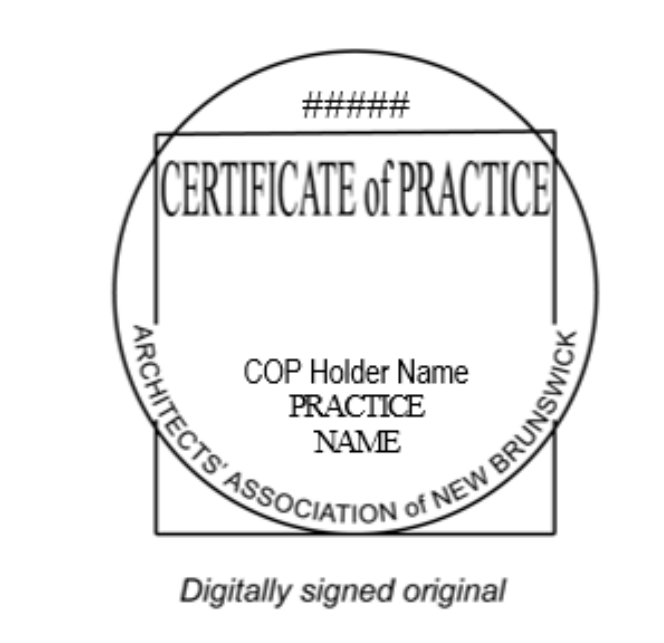
The Architects’ Association of New Brunswick issues a Certificate of Practice Stamp and a Temporary Licence Stamp.
These stamps are the property of the Association and are subject to return to the AANB upon request.
USE OF AANB STAMPS
Certificate of Practice Stamps:
Is issued to the holder of a Certificate of Practice, and bears the name of the member and the practice;
Possession of this stamp authorizes the right to practice architecture;
The issued stamp is to be signed by the individual architect named on the Certificate of Practice application as having authority to affix the stamp on behalf of the practice,
The imprint of this stamp is to be displayed prominently on the face of the drawings or documents specified by By-laws.
Temporary Licence Stamp:
Is issued to the holder of a temporary licence, and bears the name of the holder, the associate architect, the project and the expiration date of the temporary licence.
This stamp is proof that an out-of-province architect has been granted the right to practice architecture with respect to the project named thereon until the date specified;
This stamp is to be used by the temporary licence holder in all instances specified by the Act and By-laws as requiring the affixing of a stamp;
The imprint of this stamp must be signed by the holder of the temporary licence (who is also required to hold a Certificate of Practice);
The imprint of this stamp is to be displayed prominently on the face of the drawings or documents specified by By-laws.

The conditions under which the various stamps may be issued, the obligations of the holders of these stamps, and regulations regarding their use are detailed in Sections 15 and 28 of the New Brunswick Architects’ Act, and in Sections 6.4, 15.18, 15.19 and 15.20 of the By-laws of the Association.
8805 - SHARED PREMISES
Council will allow an architectural practice(s) and other business(es) to share premises, provided certain conditions are met. The intent of the following requirements is to ensure that the architectural practice is clearly identified as such. In addition to complying with the requirements of Section 6.6 of the By-laws, the following requirements must be satisfied:
- The architectural practice will conduct its affairs under its own name.
- The names of all practices/businesses sharing the premises must be prominently displayed to the general public.
- The architectural practice will maintain a separate office within the premises.
- Each practice/business must maintain separate records and filing systems. The records and files of the architectural practice must be under the direct supervision of the Architect.
- Each practice/business must either:
- Maintain a separate telephone line; or
- In the case of the practice and business sharing the same telephone number, the telephone must be answered giving the names of all practices/businesses.
- The AANB reserves the right to inspect the premises during normal business hours to ensure compliance with these requirements.
8900 SERIES
8901 - ARCHITECTS EMPLOYED BY FIRMS NOT HOLDING A CERTIFICATE OF PRACTICE
Council notes that in certain cases, Registered members may be employed by firms that do not hold a Certificate of Practice. This is acceptable if an Architect who does not hold a Certificate of Practice does not practice architecture in the course of their employment.
If an Architect is expected to practice architecture as defined by the Act, such practice must be carried on under a Certificate of Practice issued to the architect, or the employer.
If an employed Architect, who holds a certificate of practice, is to provide architectural services to their employer, these services must be solely related to structures to be used by the employer, or related businesses of the employer.
The employed Architect must ensure that it is not implied that, by their employment, the employer has the right to offer architectural services to the public, or to practice architecture.
Members should note Section 15.1.5 of the By-laws, which state:
“15.1 For the purpose of the Act and By-laws, “professional misconduct” shall include:
15.1.5 Authorizing, permitting, counselling, assisting, aiding or abetting any person who is not a member or a holder of a Certificate of Practice or a licence to engage or hold themselves out as engaging in the practice of architecture; ……”
Relevant Sections of the Act: Section 2 – Definitions; Section 12(1); Section 13(2), 13(3), 13(4); Section 14(4);
Relevant Sections of the By-laws; Section 6; Section 15.1.5
8902 - CERTIFICATE OF PRACTICE
Registration as an Architect by the Architects’ Association of New Brunswick does not grant the right to practice architecture. The right to practice is granted by the Certificate of Practice.
Every Registered Member or licensee of the Association may apply for a Certificate of Practice, which will be granted provided the requirements of the Act and By-laws have been met.
The following guidelines are a summary of the provisions of the Act and By-laws.
- Certificate of Practice will be issued in the name under which the practice of architecture is conducted. Practice names must comply with the requirements of Section 6.5.1 of the By-laws.
- Certificates of Practice may be issued to an Architect practising as a sole proprietor, or to architects practising as a partnership if the provisions of Section 12, 13.2 and 13.3 of the Act have been met.
- As provided in Section 13.4 of the Act, members may practice architecture in the name of a corporation if at least twothirds of the directors of the corporation are architects or engineers, and the majority of the issued shares are beneficially owned by and registered in the name of the architects or engineers.
Documentation Required: - Applicants who practice as a corporation shall attach to their application for a Certificate of Practice a copy of their Articles of Incorporation. Council will not consider applications from corporations if the Articles of Incorporation are not included.
- If a corporation applying for a Certificate of Practice includes officers and/or directors who are members of the APEGNB, or members of other provincial architectural or engineering associations, a letter of good standing from the registering jurisdiction must accompany the application.
- Applications for a Certificate of Practice will not be granted if the practice’s letterhead does not meet the requirements of Section 6.5.2 of the By-laws.
Documentation Required: A sample of the practice’s letterhead must be attached to the application.
See Policy Statement 8903 for further information on letterheads. - If an architect, who is an employee of a holder of a Certificate of Practices wishes to obtain a Certificate, the architect must submit with the application, a letter from their employer stating that the applicant has consent by their employer to hold a Certificate of Practice.
- The application for a Certificate of Practice shall include the name of the Registered member(s) authorized to affix the practice’s stamp in accordance with the requirements of the Act and By-laws.
- The Registered member(s) named on the application as having authority to do so, shall affix the practice’s stamp in all instances designated by the By-laws as requiring a stamp, and shall sign the imprint of the stamp.
See Policy Statement 8804 for further information on Stamps.
Relevant Section of the By- laws: Section 6
8903 - LETTERHEAD
Section 6.5.2 of the By-laws states:
“Styling of firm, company or corporate names and the composition of letterheads of persons applying for a Certificate of Practice shall be approved by Council.”
The following information is required to be included on the letterhead for approval by Council:
- Practice name.
- Complete address, including postal code.
- Telephone number.
- The names of all persons responsible for the practice of architecture. The name shall be shown separate and apart from the name of the practice.
Council encourages the use of professional designations, particularly the use of “AANB”, by Registered members.
To satisfy the requirements of Section 6.5.5 that a copy of the practice’s current letterhead be filed with the Association from time to time, each application for a Certificate of Practice shall have attached a copy of the practice’s letterhead. (See Policy Statement 8902)
Council will not accept a photocopy of letterhead unless it is clearly designated as a printer’s proof for Council approval. In such case, a sample of the printed letterhead must be filed with the Association before the Certificate of Practice will be issued.
Relevant Section of the By-laws: 6.5.1, 6.5.2, 6.5.4, 6.5.5
8904 - CHANGE OF ADDRESS
Two Sections of the By-laws deal with a member’s change of address:
Section 4.5.1 – Each individual registered or enrolled as a member shall promptly notify the Executive Director of any change of address. The mailing of a notice to the last address of the member on the records of the Association shall be deemed to constitute service of notice for any purposes of the Association.
Section 15.1 – For the purpose of the Act and By-laws, “professional misconduct” shall include:
22. Failing to notify the Registrar in writing forthwith of a change of address recorded on the register
maintained under the Act by the Registrar;
Members shall advise the Association, in writing, of any change in address. In so notifying the AANB, the member shall ensure that the new address is complete in all respects, including postal code.
Relevant Sections of the By-laws: 4.5.1
8905 - CERTIFICATION OF ACADEMIC QUALIFICATION RE REGISTRATION
Section 4.3.2 of the By-laws state:
“An applicant for Registered Membership shall…
(b) be a graduate in architecture of an accredited university, other academic or technical institution, or
program of study recognized by Council, and hold a certificate of academic qualification recognized by
Council”;
For the purpose of this section of the By-laws, Council recognizes a certificate issued by the CANADIAN ARCHITECTURAL CERTIFICATION BOARD.
Relevant Section of the Act: 9(3)
Relevant Section of the By-laws: 4.3.2
8906 - REGISTRATION EXAMINATIONS
The Examination for Architects in Canada (ExAC)
The Provincial/Territorial Architectural Licensing Authorities in Canada (Licensing Authorities) have the mandate to ensure both public safety and professional skilled delivery of architectural services in their respective jurisdictions. Mechanisms have been established to ensure the competence of architects, both when they enter the profession and throughout their professional careers. The licensing/registration examination is one of these mechanisms.
The Alberta Association of Architects (AAA), the Ontario Association of Architects (OAA) and the Ordre des architectes du Québec (OAQ) agreed to develop a new Canadian licensing/registration examination, over which they would have complete control, including its development, updates and administration.
The Examination for Architects in Canada (ExAC) which, to date, all of the Canadian Licensing Authorities have adopted, was developed to test the minimum standards of competency acquired by an Intern during the Internship period, to ensure both public safety and the professional and skilled delivery of architectural services.
The ExAC has been offered since 2008.
Preparation
The ExAC assesses the skills acquired by Interns during the Internship period, to ensure both public safety and the professional and skilled delivery of architectural services.
Some Interns feel ready to take the exam as soon as they meet the eligibility requirements, specifically once his/her Licensing Authority has approved 2800 hours of experience. Others prefer to complete the Internship in Architecture Program (IAP) before writing the exam to ensure that they are well versed in the practice of architecture.
Relevant Sections of the By-Laws: 4.3.2, 4.3.5
8907 - RECIPROCAL AND INTERNATIONAL AGREEMENT(S)
Since 1988, the AANB, and its Canadian Regulatory counterparts have entered into Agreements provided individuals have demonstrated compliance with the competency standards for licensing in Canada. In all cases, residency in New Brunswick is not considered.
In all cases, members must apply for a Certificate of Practice if they wish to practice architecture in New Brunswick. A Certificate of Practice is only granted when the Council is satisfied that the applicant will meet the intent of the AANB Act and By-Laws.
As of the writing of this Policy Statement, the AANB and the profession in Canada are signatory to the following Agreements:
- Canada: Canadian Reciprocity Agreement (between all Canadian licensing authorities)
- Canada–U.S.: Inter-Recognition Agreement between Canadian Licensing authorities and signatory U.S. states
- Canada–U.S.–Mexico: Tri-National Agreement
- Canada–Europe: Agreement between Canadian Licensing Authorities and the Architects Council of Europe (ACE)
- Canada–Australia–New Zealand: Asia-Pacific Economic Cooperation Agreement
- Canberra Accord: Intended to facilitate the portability of educational credentials between the countries whose accreditation / validation agencies signed the Accord.
Details on additional mobility Agreements and their requirements can be found here:
www.aanb.org → Members → Membership: The Process → Professional Mobility
8908 - DIGITAL SIGNATURES (NOTARIUS)
OBJECTIVE
AANB Members who have a Certificate of Practice (COP) issued by the AANB, must use the professional seal issued to them by the AANB in accordance with the rules which govern the use of the professional seals contained in Section 15 of the Architects Act and Section 6.4 of the By-Laws. Applying the seal, date and signature on a document, confirms that the document was prepared in its entirety under the personal supervision and direction of a licensed practitioner.
For clarity, the reference to documents noted in this Bulletin includes paper and electronic versions.
Prior to the AANB’s new Digital Signature/Seal policy, the AANB permitted the reproduction of the Certificate of Practice seal for use in electronic format. As of April 1, 2019, that practice is no longer permitted and any document which is to be transmitted electronically must be signed, sealed, and dated with a digital certificate as described in this Bulletin. No other means of sealing and electronically transmitted document which must be sealed is permitted.
This Bulletin will reaffirm the above noted Act and By-Law sections as they pertain to:
1. Documents which must be sealed
2. Mandatory seal characteristics and image requirements
3. Electronic application – i.e., electronic signatures and seals
BACKGROUND INFORMATION
Under the Architects Act and By-Laws, specific documents prepared under the personal supervision and direction of a member must be sealed with your certificate of practice seal, signed and dated. In addition, some items prepared in their entirety under the personal supervision and direction of a member, may be sealed at a practitioner’s discretion.
The professional seal is not intended to be used for any other purpose. Documents not prepared in their entirety under the personal supervision and direction of a licensed practitioner must not be sealed.
Practitioners are not required to affix their seal on a design in the case of an open competition in which anonymity is a requirement.
USE OF DIGITAL SEAL
If a practitioner chooses to finalize their document electronically, they must use the AANB Digital Seal (Digital Signature provided by the AANB).
Electronic impressions and seals shall not be used for the purpose of authenticating original documents. They shall not be confused with digital signatures or seals.
An image along of a seal is not secure, and any such document is vulnerable to being modified and used by others without the issuing practitioner’s knowledge or authorization. It is important to the protection of the public that the seal applied by a licensed AANB practitioner is reliable. Therefore, the Digital Seal is required for documents that are authenticated electronically. The digital seal confirms that the document was signed by an AANB licensed practitioner and that the content has not changed since it was signed.
AANB practitioners must ensure that their digital seal remains under their control to prevent unauthorized use. Authority to use a digital seal shall not be delegated to anyone nor shall the personal security codes which enable use of the digital seal by shared.
8909 - PROXIES
At the Annual Meeting held 24 February 1990, the Members voted to eliminate altogether the provisions for voting by proxy. However, the members further instructed Council to reconsider this amendment, and as a result of the subsequent discussion, council is amending Section 10.2.5 to read:
At each meeting of the Association, every Registered Member present shall be entitled to one vote. No Registered Member shall be entitled to vote at a meeting of the Association by proxy, except under the following circumstances: A Registered member who is prevented by serious illness or absence from the province form attending the meeting, may appoint another Registered Member of the Association their proxy to attend and act at the meeting for the specific purpose of voting on behalf of the Registered Member. The instrument appointing the proxy shall be in the form prescribed by Council.
The proxy must be on the form prescribed by Council and must bear the actual signature of the Registered Member.
All Members of the Association will receive a “Notice of Motion to Amend the By-laws” prior to a meeting of the Association in sufficient time to comply with this By-laws should they have reason to file a proxy.
9000 SERIES
9001 - RETIRED MEMBERS
Council was asked to consider the exact extent to which a retired member of the Association may practice architecture. In reviewing this issue, Council noted the following definitions:
“Retired Members” are individuals who have ceased the practice of architecture while Registered members in good standing: - membership is automatic upon retirement from active practice.
“Practice of architecture” means:
(a) the preparation or provision of a design to govern the construction, enlargement or alternation of a building, or the related site development,
(b) evaluating, advising on, or reporting on the construction, enlargement or alternation of a building, or the related site development,
(c) a general review of the construction, enlargement or alteration of a building, or the related site development.
“Member” means an individual who holds a Certificate of Registration issued pursuant to Section 10 of this Act;
Council was also mindful of the following Section of the Act:
14(1) The Council shall approve an application for a Certificate of Practice-to-practice architecture in New Brunswick if it is satisfied that the member, licensee, sole proprietorship, partnership or corporation applying for a Certificate has fulfilled all of the requirements of this Act and the By-laws.
23 Except as provided in this Act or the By-laws, every individual other than a member or licensee who
(a) engages in the practice of architecture;
(b) uses orally or otherwise the title “architect”, the initials “AANB”, or any name, title, description, or designation that will lead to the belief that such a person is an architect;
(c) advertises, holds themselves out or conducts themselves in any way or in any manner as an architect; or
(d) uses a stamp or seal that will lead to the belief that the person is an architect, and does not hold a valid Certificate of Practice, is guilty of an offence, punishable on summary conviction.
As the Act and By-laws clearly state that a Certificate of Practice will be issued only to Registered members or licensees, and that a Certificate is necessary to carry on the practice of architecture, a Retired member therefore cannot practice architecture.
The question was then raised as to whether a retired member could practice in the role of an employee architect if a Registered member in possession of a Certificate of Practice was willing to assume responsibility for their work. Under the provisions of the Act and By-laws are met, and that a bona-fide employer-employee relationship exists.
It is further noted that Section 6 of the By-laws provides that the names of those persons responsible for the practice of architecture will be shown on the practice’s letterhead. Should therefore, the name of a retired member appears on a practice’s letterhead, one could be misled to believe that the retired member is responsible for the practice of architecture unless the retired member is clearly designated as “retired”.
The situation was also discussed wherein a retired member may from time-to-time act as a “consultant” to a firm. If this is the case, and the retired member is providing any of the services included in the definition of the “practice of architecture” then the retired member will be in contravention of the Act, as they are not in possession of, and by the provisions of the By-laws, cannot hold a Certificate of Practice. Should a retired member entertain thoughts of acting on a “consultant” basis, it is then necessary that they be reinstated as a “registered” member and comply with the Certificate of Practice regulations.
9002 - NSF CHEQUES
From time to time, a cheque is submitted to Council in payment of membership dues or certificate of practice fees, which is returned to the Association by the bank because of non-sufficient funds.
When this happens, the membership and/or certificate of practice for which the cheque was submitted will be deemed invalid, as the application was not complete in that the required dues and fees did not accompany the application. (See Policy Statement 8802, By-laws Section 7.1, 8.5 and 4.3.2)
Further, Council will deem a member who has submitted a cheque that is returned NSF to have contravened Section 15 of the By-laws, and the following action will be taken:
In the case of a cheque for membership dues, the member will be advised that their membership has been removed from the Register for non-payment of dues. The member will then be subject, to Section 8.7 of the By-laws, which provides for a re-registration fee of not more than $250. If the member holds a Certificate of Practice at the time, it will be cancelled.
If the cheque was for a Certificate of Practice, the certificate will be immediately cancelled, and the member will return to the AANB office the Practice’s Stamp and Certificate, and will cease the practice of architecture until such time as they are once again in possession of a valid Certificate of Practice (has been cancelled), there shall be a re-application to the annual fee for a Certificate of Practice.
In addition to the above, the member will be expected to provide certified cheques to the Association in support of their re-applications and shall be responsible for reimbursing the AANB for bank charges relating to the NSF cheques.
Cheques that are returned NSF, which were submitted in settlement of accounts other than dues for COP’s will be subject to a $25 fee, plus AANB costs.