Harrison McCain Pavilion at Beaverbrook Art Gallery
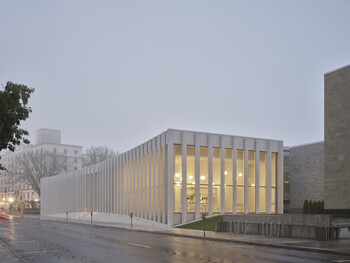
KPMB ARCHITECTSThe Harrison McCain Pavilion was conceived as the final phase of the Beaverbrook Art Gallery’s expansion, redefining the institution’s presence within Fredericton. The mandate was to design an inclusive and accessible civic gateway, while strengthening the Gallery’s architectural identity and role as a cultural anchor in the city. The design draws inspiration from Fredericton’s exceptional heritage architecture—porches, loggias, and civic facades—to establish a public building that resonates with its context and functions as a civic welcome.
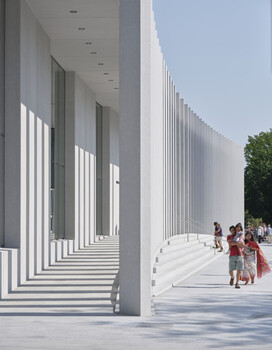
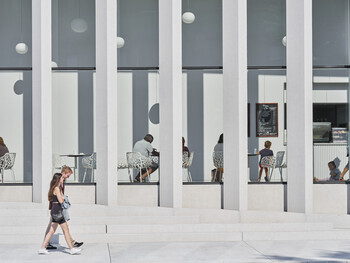
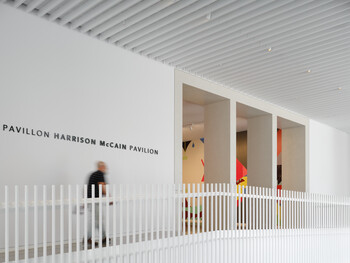
The planning concept centres on a promenade of steps and ramps that rises gently from Queen Street, improving accessibility by bridging the city and elevated galleries. Sited between the Saint John/Wolastoq River and Queen Street, the concave façade mirrors the parallel curves of the river and main street and embraces the city. A colonnade doubles as a brise soleil, blurring inside and outside while inviting all to enter.
Planning and function
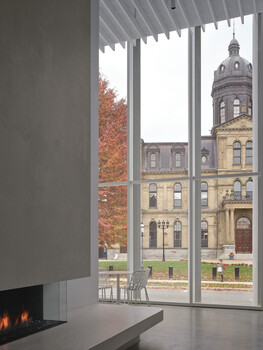
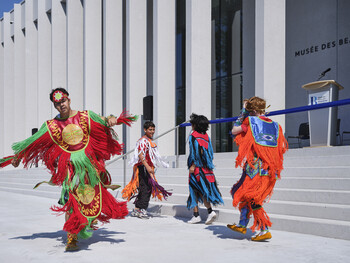
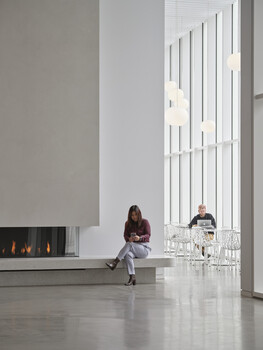
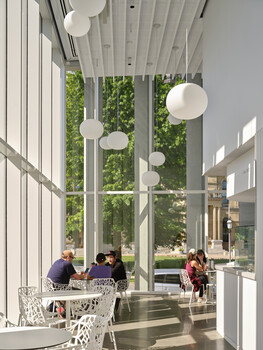
The Pavilion is an efficient, multi-functional space open to all free of charge. It houses rotating art exhibitions, community events, reception and ticketing, a café, fireplace seating, and a shop. Full-height glazing, wide steps, and barrier-free ramps ensure accessibility and intuitive wayfinding. The resulting space fulfills program requirements, while also functioning as an “urban living room”. Its strong relationship to site and community has made it a cherished hub for Indigenous peoples, long-time residents, and newcomers alike.
Built form
The façade, constructed with locally manufactured precast concrete, balances simplicity with a sensitivity to light, shadow, and rhythm. Columns radiate slightly outward, creating a dynamic kinetic quality that shifts upon approach, simultaneously revealing and concealing views. Located in a floodplain, the Pavilion floor is elevated 1.3-meters for resiliency. Local collaboration optimized construction practices, minimizing material use, site labour, and transportation.
Innovation
The Pavilion reflects evolving social values, positioning the gallery as both cultural institution and civic commons. It transcends program constraints by offering spaces for gathering, storytelling, and respite alongside art. Sustainable strategies include solar performance modelling that reduced heat gain by 43%, high-performance wall assemblies, and the Pavilion’s role as a thermal buffer to reduce operating energy demand.

Latest News

93
Years
of
Experience
444
Valued
Members
198
Architectural
Firms